
Global Car Wrap Blade Market Trends: An Underrated Multi‑Hundred‑Million‑Dollar Accessory Niche
2026-08-21If you’re in the automotive wrap industry, you handle blades every day. But have you ever stopped to think about the global market behind that small piece of steel? It’s growing fast — and most people aren’t paying attention.
Today we’re talking about film’s essential partner: professional wrap blades. The numbers tell a story — this seemingly tiny consumable category is riding a wave of structural growth.
1. Overall Market: Two Markets Driving One
To understand the blade market, look at the two markets upstream — PPF (Paint Protection Film) and vinyl wrap.
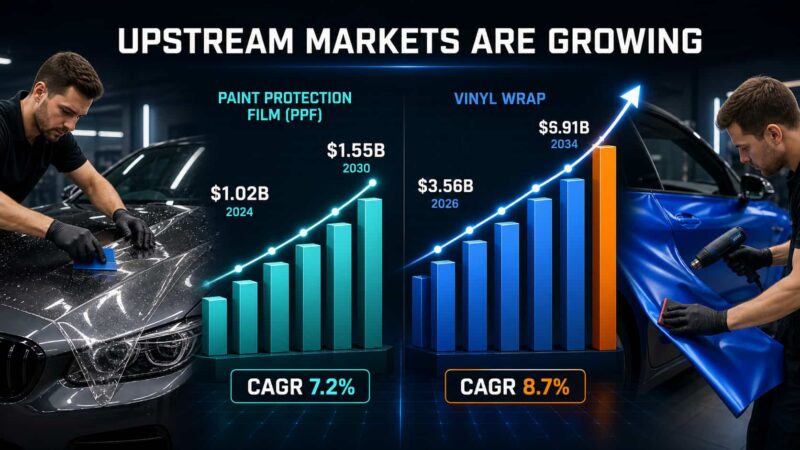
According to MarketsandMarkets, the global PPF market was valued at roughly $1.02 billion in 2024, projected to reach $1.09 billion in 2025 and $1.55 billion by 2030, a CAGR of 7.2%. Fortune Business Insights takes a more conservative but still bullish view: $630 million in 2025, growing to $1.09 billion by 2034 at a 6.2% CAGR.
Le Vinyl Wrap market is even larger. Fortune Business Insights pegs the global automotive wrap market at $3.56 billion in 2026, reaching $6.91 billion by 2034 (CAGR 8.7%). According to data from Le Insight Partners, it has reached $6.27 billion by 2025 and is expected to exceed $13.5 billion by 2034.
Every vehicle wrapped consumes blades. As the film market grows, the blade market grows right alongside it — and often faster.
2. Four Trends Shaping the Next 3 Years
Trend 1: EV Sales Growth Drives Structural PPF Demand
Reports and Data points out that EV owners — with no engine note or exhaust to differentiate them — care more about personalization and resale value, and PPF penetration rates among EV owners are significantly higher than among ICE vehicle owners.
According to the International Energy Agency, EV sales in the EU grew by over 30% year-over-year in 2025, directly boosting dealer demand for high-end wrap and paint protection solutions. Brands like 3M launched heat-resistant film lines in 2024 specifically for EV battery cooling panels.
For blades, the implication is straightforward: more installations = more blade consumption.
Trend 2: Asia-Pacific Is on the Rise
XPEL Japan projects the global PPF market will grow at a 5.3% annual rate through 2032, with China, India, Japan, and other Asia-Pacific markets leading the charge.
North America remains the largest single market (roughly 32–35% share), but Asia-Pacific’s growth rate is outpacing everyone.
For blade manufacturers and distributors, emerging markets like Southeast Asia, the Middle East, and Latin America may offer bigger opportunities than mature ones.
Trend 3: TPU Dominance Raises the Bar for Blades
Meticulous Research reports that by 2025, TPU (thermoplastic polyurethane) will account for over 80% of the PPF market. Compared to traditional PVC, TPU is thicker, more elastic, and self-healing — but also significantly harder to cut.
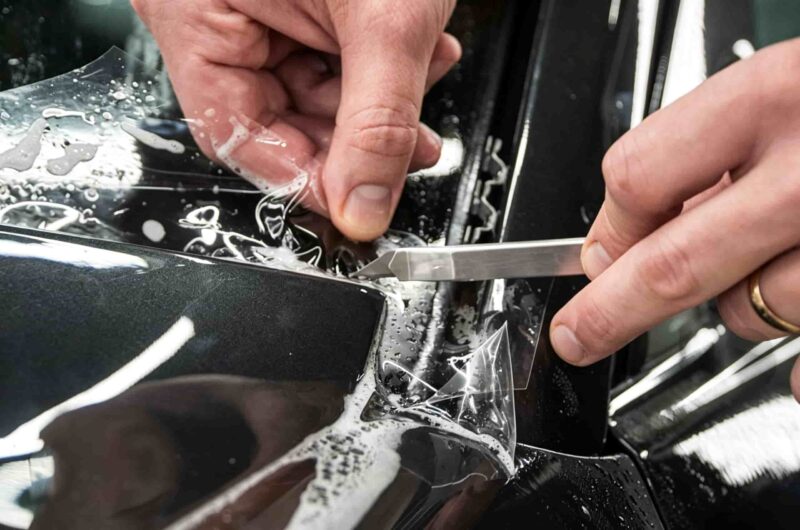
The result: generic blades struggle with TPU. You get ragged edges and blade skip. Installers need sharper, longer-lasting professional-grade blades. That’s exactly why the 30° acute-angle blade has become the industry standard — its sharp angle slices through thick film with less resistance and a cleaner cut.
Trend 4: Professional Tool Upgrade — From “Good ” to “Professional“
In the past, many wrap shops grabbed whatever snap of utility blades were on sale at the hardware store. But now, the industry is in the middle of a professional blade upgrade.
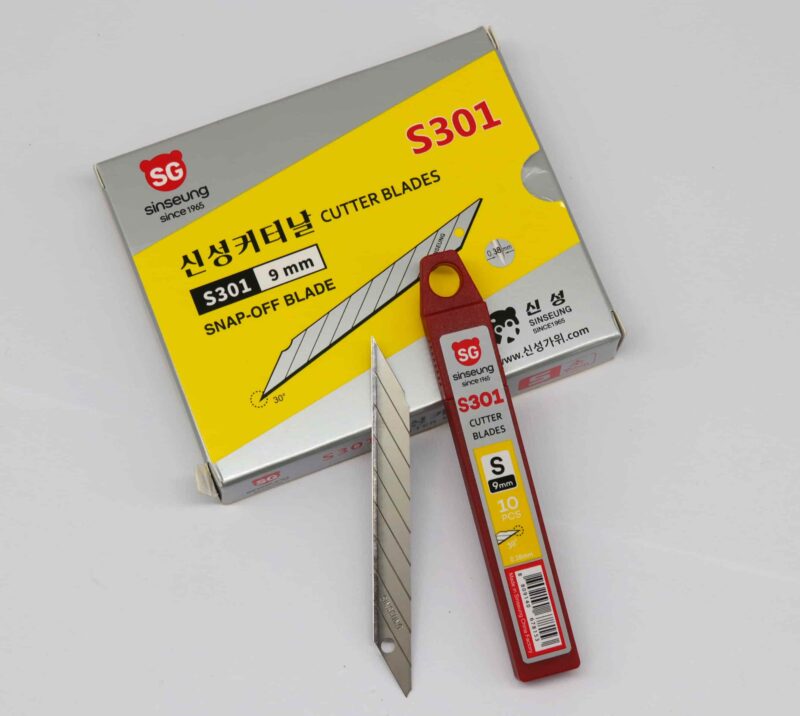
Brands like SINSEUNG, OLFA, and NT Cutter are promoting the “professional wrap blade” concept worldwide — pushing sharpness and durability to new levels.
3. Three Actionable Takeaways for Industry Players
3.1. Stop competing on price — compete on “Cost per Cut” A cheap blade goes dull after 3 uses. A quality blade stays sharp through 10+. Do the math — it beats haggling every time.
3.2. Lock in the 30° acute-angle + SK2 high-carbon steel combo. This is the professional standard for PPF and vinyl wrap installation, and the thicker the TPU, the bigger the advantage. Black coating adds rust resistance and reduces film adhesion — a solid bonus.
3.3. Target distributors in emerging markets. North America and Europe are mature and competitive. Shops in Southeast Asia, the Middle East, and Latin America are scaling fast and hungry for cost-effective professional blades — right now is the window to build those channels.
4. FAQ
Q1: What’s the difference between a 30° blade and a 45° blade?
A1: A 30° acute angle is sharper, cuts through thick film (especially TPU-based PPF) with less resistance, and leaves a cleaner edge. A 45° blade lacks that sharpness, requires more force to cut, and is better suited for thin paper.
Q2: Black-coated blades vs. regular silver blades — which is better?
A2: Black coating (typically Teflon or an oxide treatment) offers two key benefits: First, rust resistance — wrap work involves constant contact with water and installation solution, and silver blades corrode easily. Second, it reduces film adhesion for smoother cutting. But coating quality varies wildly — cheap coating flakes off after a few uses and can actually contaminate the film surface.
Q3: How often should I replace my blade?
A3: As a general rule: for TPU-based PPF, swap the blade after 1–2 vehicles. For standard vinyl wrap, you can stretch it to 3–4 vehicles. The tell is simple — if cutting resistance goes up or edges start fraying, it’s time.
Q4: How do I tell if a blade uses quality steel?
A4: Three quick checks:
- Inspect the edge — quality steel shows a uniform, fine line under light, no nicks or burrs.
- Feel the cut — a good blade glides through material without that “chattering” skip sensation.
- Test durability — under the same usage, a quality blade lasts 2x+ longer.
SINSEUNG’s 30° blades are made with SK2 high-carbon steel, the mainstream material for professional-grade blades today.
Précédent : how-safety-cutter-knives-reduce-workplace-cutting-risks
Suivant : what-are-box-cutter-blades-made-of
-
 Are Box Cutter Blades Universal?Explain box cutter blade compatibility by width, holder channel, lock design, refill format, and model matching for trade buyers.2026/10/01
 -
How to Safely Snap Off a Utility Knife BladeLearn how to snap off a box cutter blade with controlled extension, safe break direction, secure containment, and practical S103 workstation checks.2026/09/24
-
30 vs 45 Degree Cutter Blades for PrecisionLearn how 30 and 45 degree cutter blade tips affect precision, durability, PPF trimming, and wholesale blade selection.2026/09/24